DEDNAED
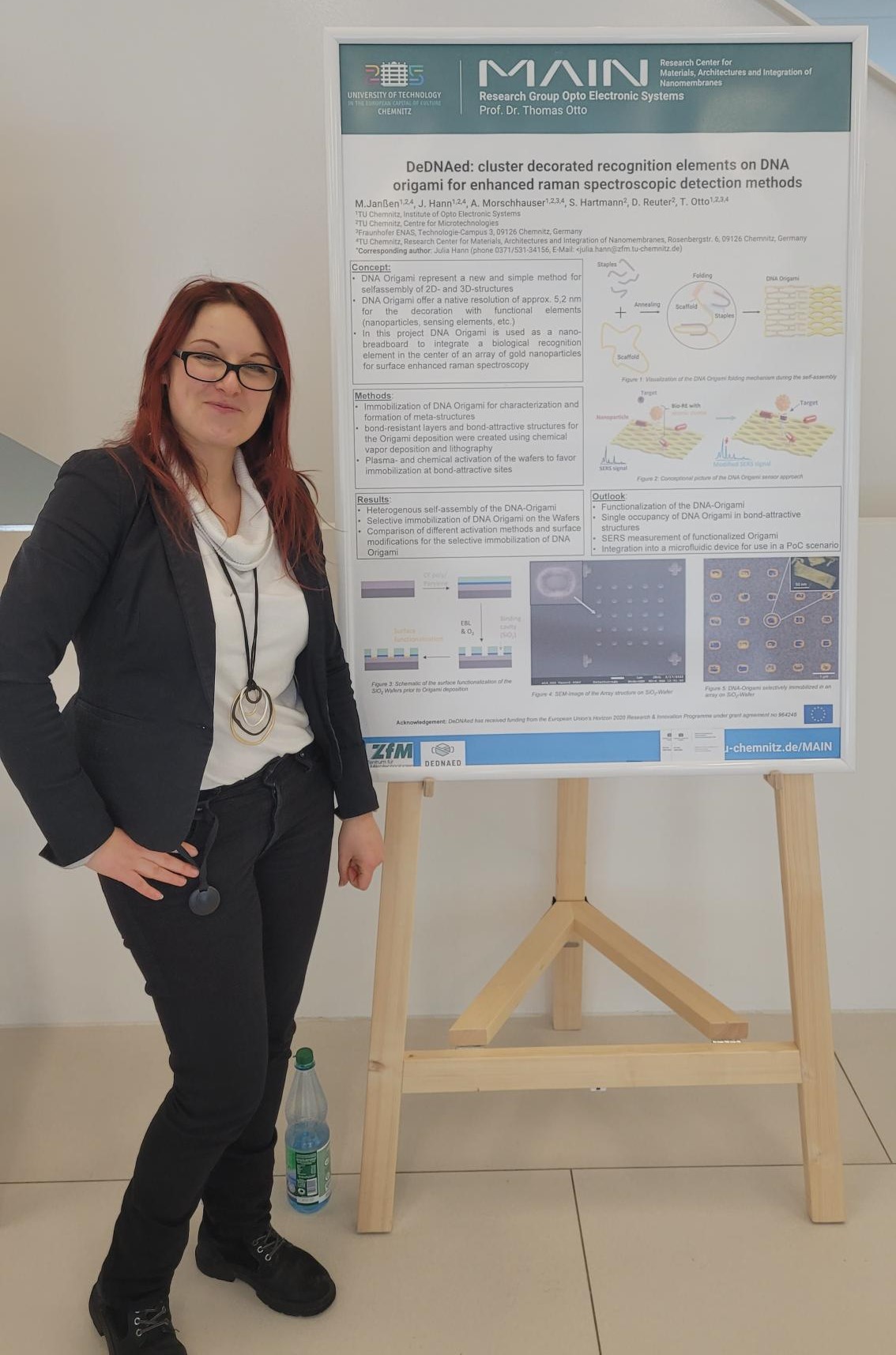
Cluster decorated recognition elements on DNA origami for enhanced raman spectroscopic detection methods
Our project
The project intends to develop a novel,
innovative biosensing platform whose advantages
and benefits are in terms of sensitivity,
versatility and being ultrafast by an optical
approach. Our platform will be based on the
assembly and integration of sensing elements
(transducer and bioreceptor) by DNA origami. The
DNA origami will serve as a “nano-breadboard” in
order to precisely control the position of these
elements and thus the sensor architecture at the
nanometer scale.
key facts
About the
project
4242
Months duration
77
international partners
44
countries involved
2.93
Mio. € overall budget
Our
Objectives
The research concept results in the following, overarching
objectives of the project:
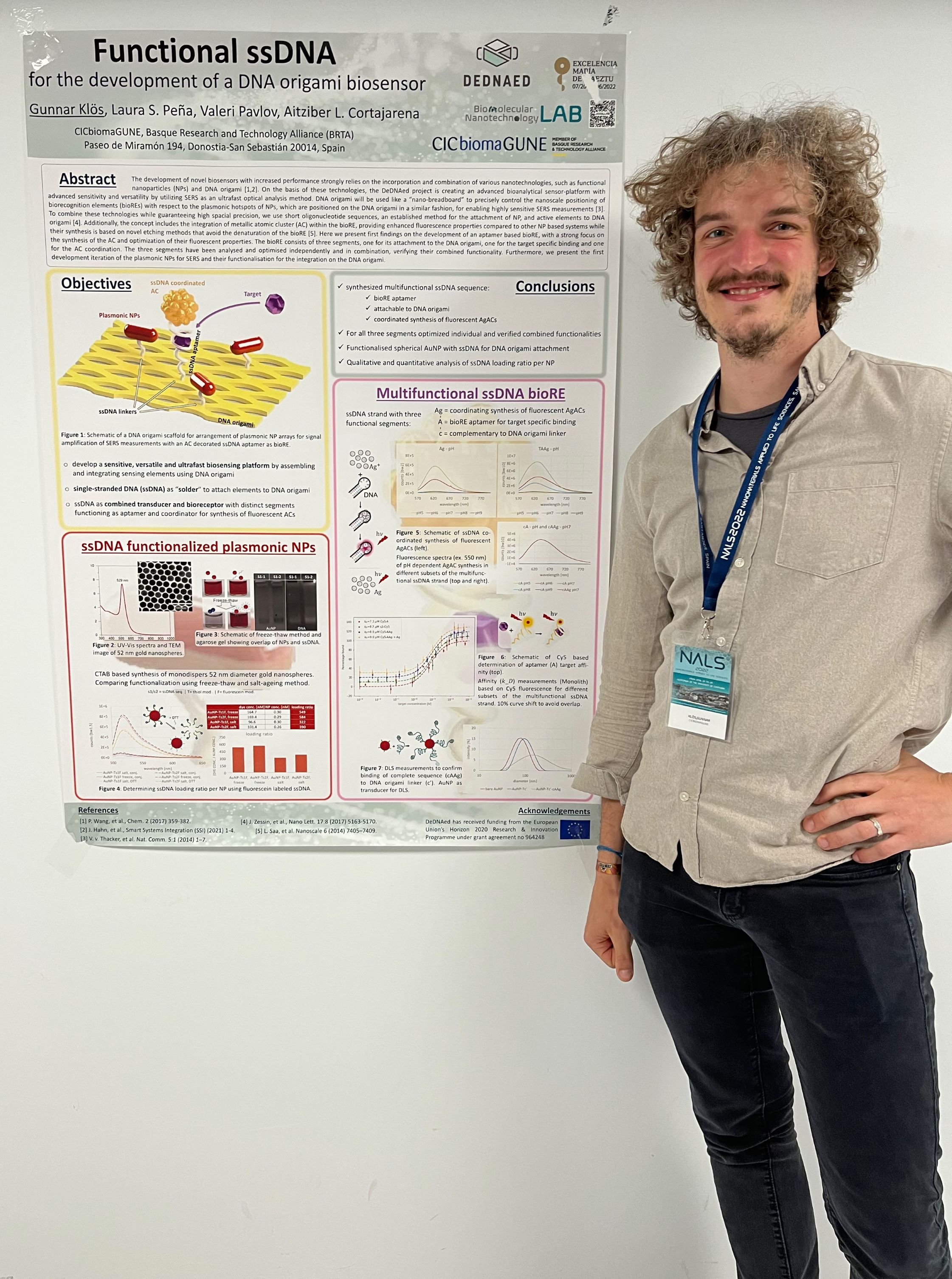
The project “DeDNAed” intends to develop a novel, innovative biosensing platform whose advantages and benefits are in terms of sensitivity, versatility and being ultrafast by an optical approach. Our platform will be based on the assembly and integration of sensing elements (transducer and bioreceptor) by DNA origami. The DNA origami will serve as a “nano-breadboard” in order to precisely control the position of these elements and thus the sensor architecture at the nanometer scale.
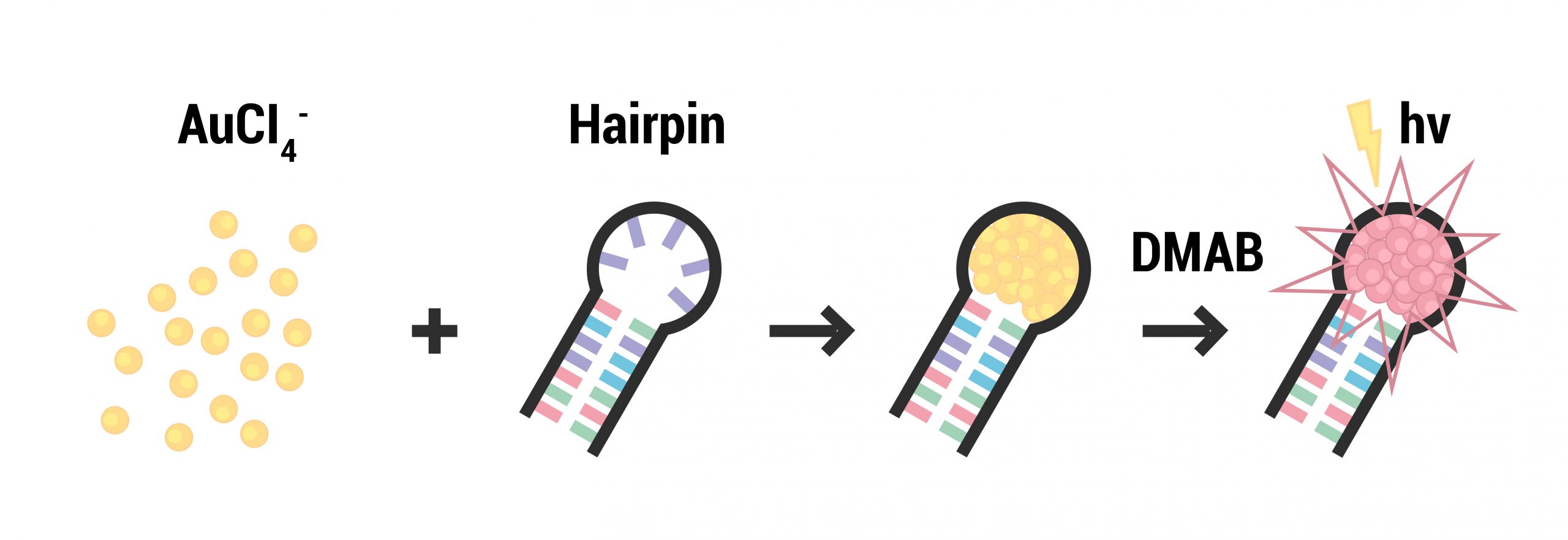
Figure 1: Schematic formation of fluorescent DNA-hosted Au-nanoclusters and the hairpin DNAs, single-stranded DNAs and fully matched DNAs.
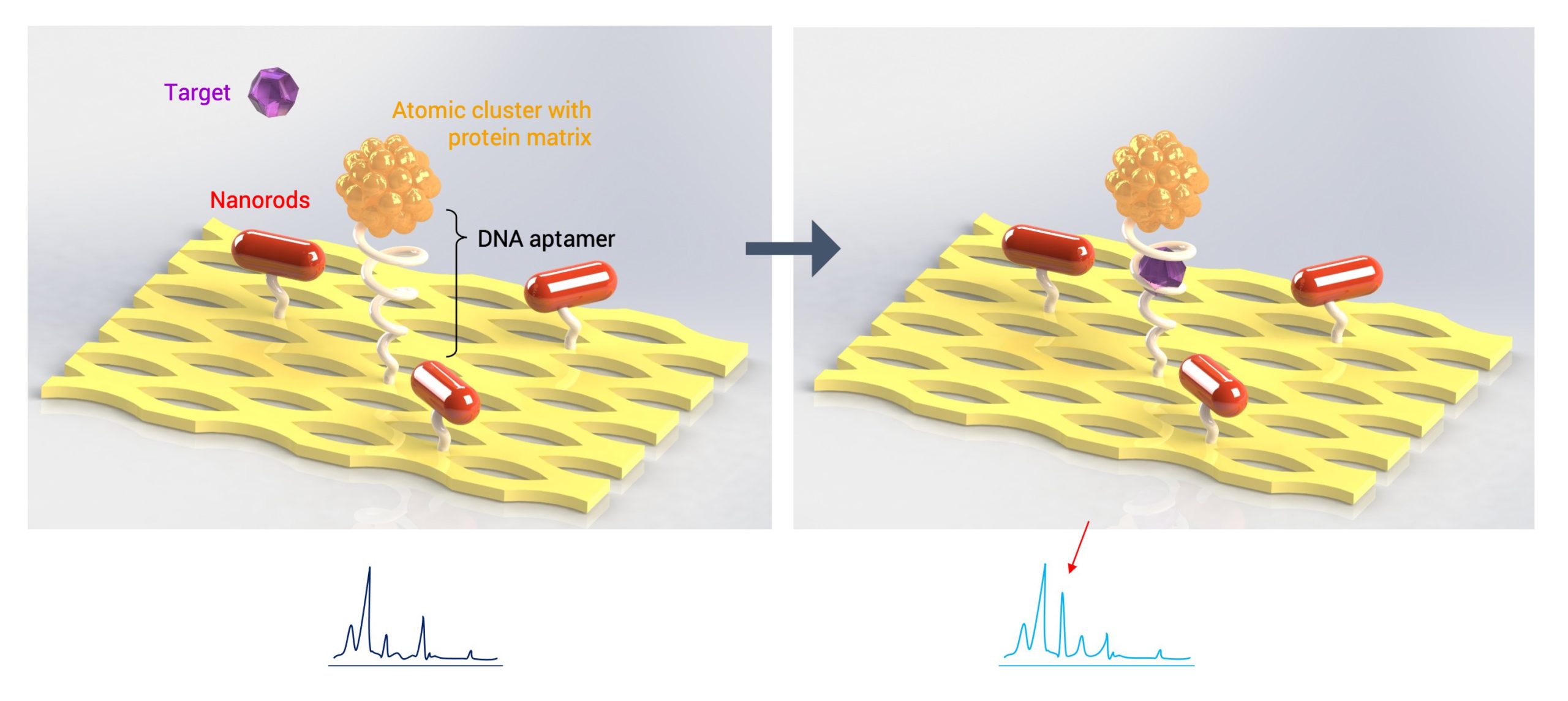
Metallic atomic clusters (ACs) are integrated into a biological marker molecule (DNA or antibody) and thus represent the biological sensor element (Fig. 1). This is specifically integrated into a nanoarray, made of additional metallic nanoparticles, precisely controlled by a DNA origami template and will lead to a significant increase in signal. The DNA origami serves as an individually, inter- and intramolecularly programmable “nano-breadboard”. A DNA origami consists of a single strand of DNA, folded by a thermal treatment and certain staple strands into any shapes (2D as well as 3D, dimensions of approx. 100 nanometers). So-called “sticky ends” on the surface of the DNA origami offer the possibility of an individual implementation of the sensing elements and nanoparticles, by means of correspondingly complementary oligonucleotides with a resolution of approx. 2 nm. When the analyte is connected to the sensor element, a change in the Raman signal can thus be detected without major delay using surface-enhanced Raman spectroscopy (SERS), as depicted in Fig.2.
Figure 2: Schematic sketch of the change in the SERS signal upon binding of the analyte to the biological marker molecule (e.g. DNA aptamer).
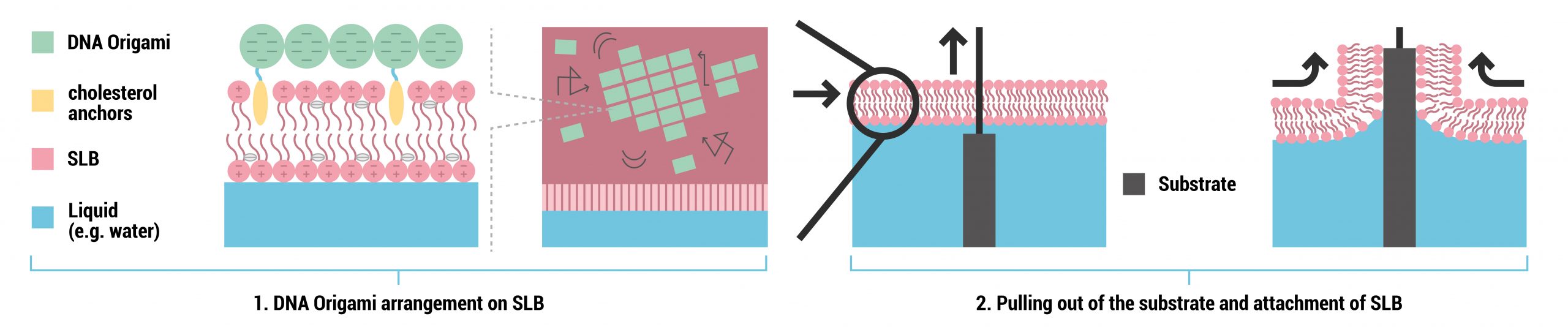
This sensor method is not bound to a specific biomarker molecule for the sensor element, but can be transferred to different marker molecules. This results in a high degree of flexibility in the area of application, from medical technology to food monitoring. In addition, a transfer of the DNA origami-based sensor platform to flexible, textile substrates is carried out using lipid bi-layers and the Langmuir-Blodgett method for later use as a wipe test or medical wearable (Fig. 3).
Figure 3: Schematic sketch of the large scale arrangement of DNA origami based sensor array on supporting lipid-bilayers (SLB) anchored by cholesterol units and the transfer mechanism to flexible substrate by LB.
who we are
Our partners
The DeDNAed team consists of 7internationalpartners from Austria, France, Germany and Spain.
The center of microtechnologies (ZfM) is a research center at the Technische Universität Chemnitz, active in the fields of advanced technologies for microelectronics, microsystems and silicon micromachining as well as nanotechnologies. We have more than 30 years of experience in the field of wafer processing for system integration using top-down technologies in combination with around 1000 m² of clean room environment.
In addition to the honorable task of project coordination of DeDNAed, the ZfM will be responsible for the integration of the DNA origami hybrids on different surfaces to enable characterization and application of the biosensor platform. We are developing a suitable thin-film system on silicon wafers with optimized surface properties using CVD, electron beam lithography and plasma etching in order to create binding points that are adapted to the small sizes of DNA origami in the range of 100 nm and less. The process of self-organized selective surface immobilization of the DNA origami hybrid structures is also implemented by the ZfM, based on the knowledge that has been gained in the field of the bottom-up technologies and especially their surface integration in recent years through various projects and collaborations (cfaed, MERGE, Bio4Comp, …) for CNTs, QDs and DNA origami. This includes, next to silicon-based substrates, also flexible ones such as polymers or paper on which DNA origami hybrid structures will be deposited using the Langmuir-Blodgett process.
The Center for Cooperative Research in Biomaterials- CIC biomaGUNE, is a non-profit research organization created to promote scientific research and technological innovation in the Basque Country (Spain). CIC biomaGUNE develops high-level research at the interface between chemistry, physics, and biology, with particular emphasis on the properties and applications of nanostructures at the biomolecular level.
In particular, the Biomolecular Nanotechnology group led by Prof. Aitziber L. Cortajarena, focuses on the engineering of biomolecules towards the generation of functional nanostructures and bioinspired materials for applications in nanobiotechnology and nanomedicine. Within the group principal investigator Dr. Valery Pavlov leads the Biosensing research line involved in DeDANed. He has extensive experience in selection and synthesis of DNA aptamers for several target proteins and its application for development of highly sensitive and specific analytical assays.
Our contribution to the DeDNAed project will be the design, synthesis, and characterization of different sensing biorecognition elements (antibodies and DNA aptamers) in pure state and modified with metallic and semiconductor atomic clusters. We will also design, synthesize, and provide metallic nanoparticles of different size and shape as amplifiers of optical read out signals.
The Kurt-Schwabe-Institut für Mess- und Sensortechnik Meinsberg e.V. (KSI Meinsberg) is responsible for the design, the synthesis and the structural characterization of DNA origami. Additionally, the synthesis of DNA origami hybrids, and thus, the arrangement of recognition elements and nanoparticles in envisioned position for SERS measurements, is a main task of KSI in the project. The structural characterization of the sensor assembly as a whole will be performed at KSI, too.
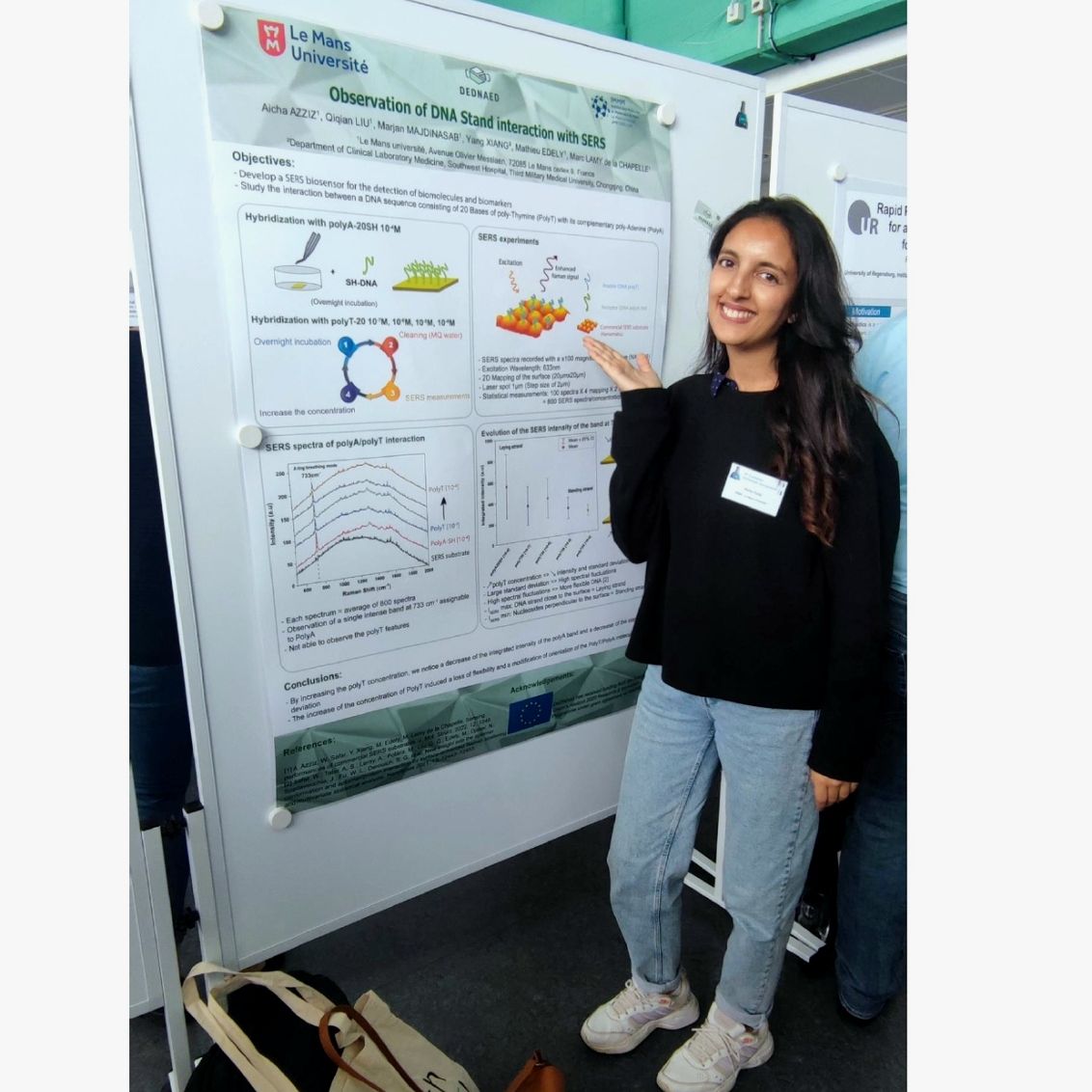
The Institute of Molecules and Materials of Le Mans (IMMM) will be in charge of the characterization of the optical and plasmonic properties of the nanostructures included in the bioanalytical platform. The Institute will also determine the SERS efficiency and the sensing performances of the platform. Finally, it will be involved in the validation of the sensor for food and biomedical applications.
The role of the group of Molecular Bioanalytics and Bioelectronics at the Institute of Biochemistry and Biology at University Potsdam is to benchmark the methodological progress of the project against established methods. Hence, sensor results will be validated in our labs by using standard methods. Here, we focus on microtiter plate-based analyses as well as kinetic measurements for system validation.
TECNALIA Research & Innovation is a private, independent, non-profit applied research centre of international excellence. TECNALIA is the leading private and independent research and technology organization in Spain and one of the largest in Europe, whose mission is to transform technology into GDP to improve people’s quality of life, by creating business opportunities for companies, being member of BRTA (Basque Research and Technology Alliance).
The main tasks of the Biomaterials Area of TECNALIA in the present project will be the incorporation of the ACs inside of antibodies, the screening of oriented immobilization of antibodies on surfaces, functionalization of flexible polymer for DNA origami immobilization and validation of the system for IL-6 detection. In parallel, Tecnalia will participate in the definition of the exploitation strategy of results.
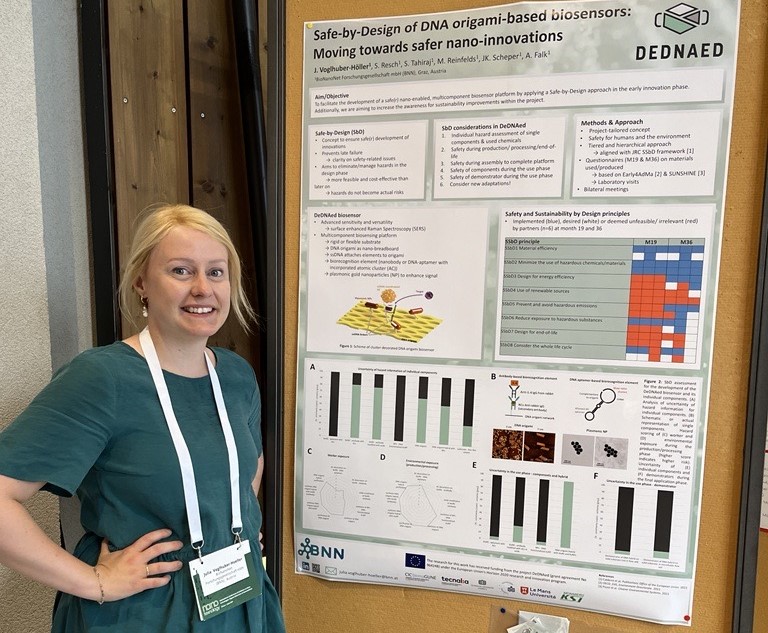
BioNanoNet Forschungsgesellschaft mbH is a non-profit research organization, specialized in international R&D&I collaboration that supports and guides its members and customers towards a sustainable development of connected technologies. The core of BNN activities and expertise are based on: (a) Building alliances and initiatives, (b) Technical support based on Safe-by-Design and sustainability aspects, supporting the development of materials, processes and products (e.g. safety and sustainability aspects along the value chain, nano-related safety-assessment, Safety-by-Design and Sustainability-by-Design implementation), (c) Innovation support and management, and (d) Complementary business support (e.g. high-quality project management in multidisciplinary projects on international level, dissemination and communication support, proven experience in organizing workshops and scientific trainings).
Within DeDNAed, BNN will be engaged in Dissemination and Exploitation tasks, such as constructing and maintaining the project’s website as well as preparing and implementing the dissemination strategy. Moreover, BNN will be involved in the Coordination and Management of the project, for instance with the development of the project quality plan. Finally, BNN will develop a Safe-by-Design concept, considering nano- and biosafety aspects.
We use cookies on our
website. Some of them are essential, while others help us to improve
this website and your experience.If you are under 16 and
wish to give consent to optional services, you must ask your legal
guardians for permission.We use cookies and other
technologies on our website. Some of them are essential, while others
help us to improve this website and your experience.Personal data may be
processed (e.g. IP addresses), for example for personalized ads and
content or ad and content measurement.You can find more
information about the use of your data in our privacy policy.You can revoke or adjust
your selection at any time under Settings.
If you are
under 16 and wish to give consent to optional services, you must
ask your legal guardians for permission.We use cookies
and other technologies on our website. Some of them are
essential, while others help us to improve this website and your
experience.Personal data
may be processed (e.g. IP addresses), for example for
personalized ads and content or ad and content
measurement.You can
find more information about the use of your data in our privacy
policy.Here you will
find an overview of all cookies used. You can give your consent
to whole categories or display further information and select
certain cookies.













 powered by Borlabs Cookie